Consumption habits, perceptions, and knowledge about hops among beer consumers in Santa Catarina, Brazil
DOI:
https://doi.org/10.58951/fstoday.2026.004Keywords:
Craft beer, Consumer behavior, Consumer acceptance, Correspondence analysis, Whole-cone hopsAbstract
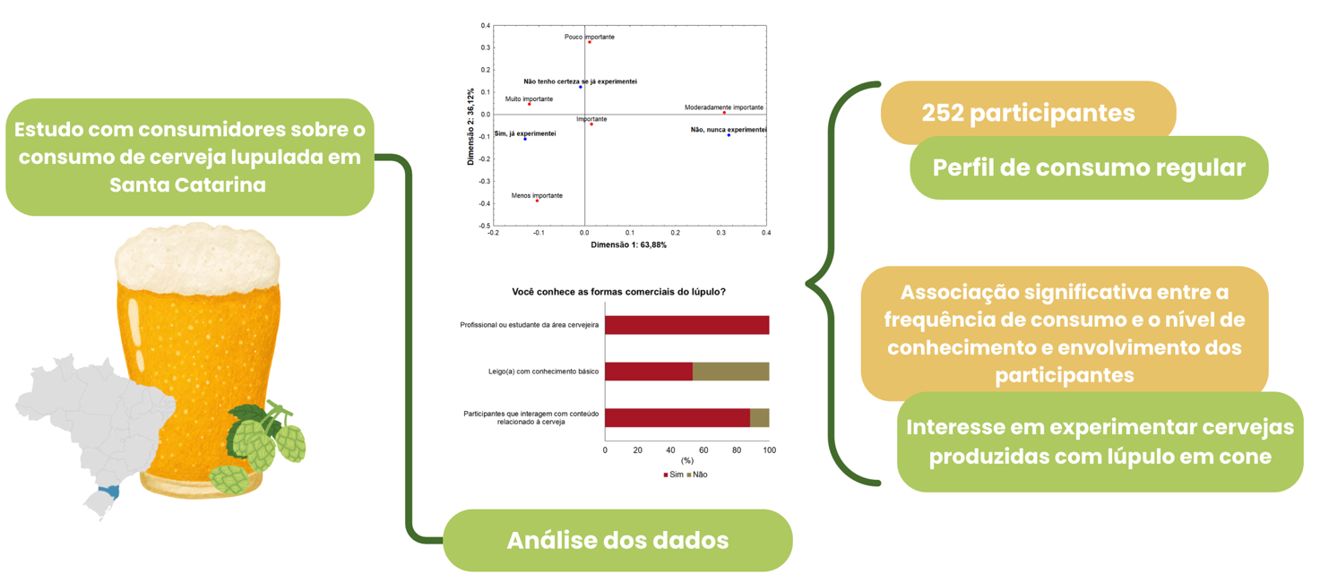
In Brazil, the craft beer market has been expanding, mainly to meet the demand for differentiated products. In this context, the production of hop-forward beers has increased to meet demand in this market segment. Given the growing appreciation of quality and differentiation attributes, this study aimed to evaluate the consumption habits, perceptions, and level of knowledge of beer consumers in Santa Catarina, Brazil, with an emphasis on ingredients and hop-forward beers. To this end, a structured online questionnaire was administered and completed by 252 participants. Beer was the most frequently reported favorite beverage (n = 185). Correspondence analysis indicated an association between the frequency of alcoholic beverage consumption and favorite beverage, with weekly consumption clustered near beer. An association was also observed between consumption frequency and knowledge/engagement levels, with consumption two to three times per week associated with participants who interact with beer-related content. Most participants reported knowing what hops are (n = 218). In addition, 87% reported knowing and having consumed India Pale Ale. Regarding beers produced with whole-cone hops, 81 participants reported having consumed them, whereas 101 were unsure; among those who had not consumed them or were uncertain, 98% expressed interest in trying them. After a brief explanation of their sensory benefits, 48% indicated willingness to pay more. Overall, the results suggest that greater involvement with the category and appreciation of ingredients are associated with more regular consumption patterns. These findings provide the brewing industry with practical input for product development, labeling, and market positioning. The high interest in trying beers made with whole-cone hops (98%), together with the willingness to pay more expressed by 48% of participants after the sensory benefits were communicated, highlights a market opportunity for this segment.
References
Almeida, A. da R., & Conto, L. C. de. (2024). Lúpulo no Brasil: Uma cultura promissora em ascensão. Food Science Today, 3(1), 1–7. https://doi.org/10.58951/fstoday.2024.001 DOI: https://doi.org/10.58951/fstoday.2024.001
Atallah, S. S., Bazzani, C., Ha, K. A., & Nayga, R. M. (2021). Does the origin of inputs and processing matter? Evidence from consumers’ valuation for craft beer. Food Quality and Preference, 89, 104146. https://doi.org/10.1016/j.foodqual.2020.104146 DOI: https://doi.org/10.1016/j.foodqual.2020.104146
Baiano, A. (2025). The willingness to pay for non-alcoholic beer: A survey on the sociodemographic factors and consumption behavior of Italian consumers. Foods, 14(13), 2399. https://doi.org/10.3390/foods14132399 DOI: https://doi.org/10.3390/foods14132399
Bonatto, D. (2026). A new classification system of beer categories and styles based on large-scale data mining and self-organizing maps of beer recipes. Food and Humanity, 6, 101083. https://doi.org/10.1016/j.foohum.2026.101083 DOI: https://doi.org/10.1016/j.foohum.2026.101083
Brasil. Ministério da Agricultura e Pecuária. (2025). Anuário da Cerveja 2025: ano referência 2024. Secretaria de Defesa Agropecuária. Departamento de Inspeção de Produtos de Origem Vegetal. Brasília: MAPA. 68 p. Disponível em: <http://192.168.3.118:8080/handle/1/6055>
Calvo-Porral, C., Rivaroli, S., & Orosa-Gonzalez, J. (2020). How consumer involvement influences beer flavour preferences. International Journal of Wine Business Research, 32(4), 537–554. https://doi.org/10.1108/IJWBR-10-2019-0054 DOI: https://doi.org/10.1108/IJWBR-10-2019-0054
Camiloti, J. V. de S., Brito, N. L. H., Martins, K. P., Cardoso, F. A. R., & Demczuk Junior, B. (2025). Consumer perception and label evaluation of craft beer in Brazil: A mixed-method study on preferences, packaging, and purchase drivers. Future Foods, 12, 100770. https://doi.org/10.1016/j.fufo.2025.100770 DOI: https://doi.org/10.1016/j.fufo.2025.100770
Capitello, R., Bazzani, C., & Begalli, D. (2026). Demand for craft beer and craft wine: A choice experiment across on-premise contexts. Food Quality and Preference, 138, 105834. https://doi.org/10.1016/j.foodqual.2025.105834 DOI: https://doi.org/10.1016/j.foodqual.2025.105834
Carisma, N. A. S., & Calingacion, M. N. (2025). Metabolomics and (craft) beers – recent advances. Food Research International, 205, 116010. https://doi.org/10.1016/j.foodres.2025.116010 DOI: https://doi.org/10.1016/j.foodres.2025.116010
Chirakranont, R., & Sakdiyakorn, M. (2022). Conceptualizing meaningful tourism experiences: Case study of a small craft beer brewery in Thailand. Journal of Destination Marketing & Management, 23, 100691. https://doi.org/10.1016/j.jdmm.2022.100691 DOI: https://doi.org/10.1016/j.jdmm.2022.100691
Duarte, P. F., Nascimento, L. H. do, Bandiera, V. J., Fischer, B., Fernandes, I. A., Paroul, N., & Junges, A. (2024). Exploring the versatility of hop essential oil (Humulus lupulus L.): Bridging brewing traditions with modern industry applications. Industrial Crops and Products, 218, 118974. https://doi.org/10.1016/j.indcrop.2024.118974 DOI: https://doi.org/10.1016/j.indcrop.2024.118974
González-Salitre, L., González-Olivares, L. G., & Basilio-Cortes, U. A. (2023). Humulus lupulus L. a potential precursor to human health: High hops craft beer. Food Chemistry, 405, 134959. https://doi.org/10.1016/j.foodchem.2022.134959 DOI: https://doi.org/10.1016/j.foodchem.2022.134959
Gorman, M., Stright, A., Baxter, L., Moss, R., & McSweeney, M. B. (2024). An analysis of consumer perception, emotional responses, and beliefs about mead. International Journal of Food Science and Technology, 59(10), 7426–7435. https://doi.org/10.1111/ijfs.17483 DOI: https://doi.org/10.1111/ijfs.17483
Haddad, F. F., Ribeiro, A. P. L., Vieira, K. C., Pereira, R. C., & Carneiro, J. de D. S. (2023). Specialty beers market: a comparative study of producers and consumers behavior. British Food Journal, 125(4), 1282–1299. https://doi.org/10.1108/BFJ-10-2021-1090 DOI: https://doi.org/10.1108/BFJ-10-2021-1090
Jaeger, S. R., Worch, T., Phelps, T., Jin, D., & Cardello, A. V. (2020). Preference segments among declared craft beer drinkers: Perceptual, attitudinal and behavioral responses underlying craft-style vs. traditional-style flavor preferences. Food Quality and Preference, 82, 103884. https://doi.org/10.1016/j.foodqual.2020.103884 DOI: https://doi.org/10.1016/j.foodqual.2020.103884
Konfo, T. R. C., Koudoro, A. Y., Tchekessi, C. K. C., Chadare, F. J., Avlessi, F., & Sohounhloue, C. K. D. (2025). Harnessing artificial intelligence for the analysis of complex chemical combinations, paving the way for novel flavors in food manufacturing: A comprehensive review. Food Chemistry Advances, 9, 101177. https://doi.org/10.1016/j.focha.2025.101177 DOI: https://doi.org/10.1016/j.focha.2025.101177
Lino, T., Forte, T. G. W., Rodolfi, M., Costantini, A., Galaverni, M., Forestello, G., Carbone, K., Tsolakis, C., Pulcini, L., Bonello, F., Petrozziello, M., Beghè, D., Marieschi, M., Asproudi, A., Ragkousi, V., Cravero, M. C., & Ganino, T. (2026). Exploring the interplay of hop variety, harvest time and yeast: Sensory and chemical dynamics in beer brewing. Applied Food Research, 6(1), 101729. https://doi.org/10.1016/j.afres.2026.101729 DOI: https://doi.org/10.1016/j.afres.2026.101729
Machado, G. A., Thomé, K. M., & Leitão, F. O. (2026). Market differentiation: practices and socio-technical agencing in the craft beer market. International Journal of Wine Business Research, 38(1), 114–129. https://doi.org/10.1108/ijwbr-08-2024-0048 DOI: https://doi.org/10.1108/IJWBR-08-2024-0048
Merlino, V. M., Blanc, S., Massaglia, S., & Borra, D. (2020). Innovation in craft beer packaging: Evaluation of consumer perception and acceptance. AIMS Agriculture and Food, 5(3), 422–433. https://doi.org/10.3934/agrfood.2020.3.422 DOI: https://doi.org/10.3934/agrfood.2020.3.422
Meyerding, S. G. H., Bauchrowitz, A., & Lehberger, M. (2019). Consumer preferences for beer attributes in Germany: A conjoint and latent class approach. Journal of Retailing and Consumer Services, 47, 229–240. https://doi.org/10.1016/j.jretconser.2018.12.001 DOI: https://doi.org/10.1016/j.jretconser.2018.12.001
Nascimento, A. do, Santos, L. S. dos, Costa, L. A., Machado, B. G., Lepaus, B. M., & São José, J. F. B. de. (2026). Consumer knowledge, attitudes, and perceptions on the application of ultrasound for fruit and vegetable preservation. Heliyon, 12(10), e44984. https://doi.org/10.1016/j.heliyon.2026.e44984 DOI: https://doi.org/10.1016/j.heliyon.2026.e44984
Nascimento, L. B. S., Sousa, C. R. de A., Levino, D. W., Ferreira, L. A., Queiroz, L. A. de, Lima, R. B. S. de, & Vieira, K. V. M. (2025). Produção de cerveja e importância da Saccharomyces cerevisiae. Food Science Today, 4(1), 91–103. https://doi.org/10.58951/fstoday.2025.011 DOI: https://doi.org/10.58951/fstoday.2025.011
Nave, E., Duarte, P., Rodrigues, R. G., Paço, A., Alves, H., & Oliveira, T. (2022). Craft beer – a systematic literature review and research agenda. International Journal of Wine Business Research, 34(2), 278–307. https://doi.org/10.1108/ijwbr-05-2021-0029 DOI: https://doi.org/10.1108/IJWBR-05-2021-0029
Nesselhauf, L., Deker, J. S., & Fleuchaus, R. (2017). Information and involvement: the influence on the acceptance of innovative wine packaging. International Journal of Wine Business Research, 29(3), 285–298. https://doi.org/10.1108/ijwbr-08-2016-0026 DOI: https://doi.org/10.1108/IJWBR-08-2016-0026
Nicholls, E. (2026). “More Than Just a Vehicle for Getting Drunk”: Class, (Serious) Leisure and the Discerning ‘No and Low’ Craft Beer Drinker. Leisure Sciences, 48(4), 760–777. https://doi.org/10.1080/01490400.2024.2335922 DOI: https://doi.org/10.1080/01490400.2024.2335922
Oyinseye, P., Suárez, A., Saldaña, E., Fernández-Zurbano, P., Valentin, D., & Sáenz-Navajas, M.-P. (2022). Multidimensional representation of wine drinking experience: Effects of the level of consumers’ expertise and involvement. Food Quality and Preference, 98, 104536. https://doi.org/10.1016/j.foodqual.2022.104536 DOI: https://doi.org/10.1016/j.foodqual.2022.104536
Pusiak, R. J. P., Overy, D. P., Liu, R., & Harris, C. S. (2026). Fruit of the bine: exploring the chemodiversity of cultivated hops (Humulus lupulus L.). Botany, 104, 1–15. https://doi.org/10.1139/cjb-2025-0054 DOI: https://doi.org/10.1139/cjb-2025-0054
Reitenbach, A. F., Lorenzi, A. S., Broch, A. C., Frade, A. F., Santamaria, K. de M., Ghest, G. F., Santos, P. C. M. dos, Santiago, P. B., Machado Junior, J. C., Zarnkow, M., & Burin, V. M. (2026). Catharina Sour: Innovation in the first Brazilian craft beer style – From tradition to the sensory exploration of Brazilian tropical fruits. Food Chemistry Advances, 10, 101201. https://doi.org/10.1016/j.focha.2025.101201 DOI: https://doi.org/10.1016/j.focha.2025.101201
Rodríguez-Velazco, Y. G., Mayorga-Martínez, A. A., Clorio-Carrillo, J. A., Lozano-De la Garza, B., Castillo-Álvarez, A., Gonzalez Viejo, C., Fuentes, S., Villarreal-Lara, R., & Hernández-Brenes, C. (2026). Drivers of consumer liking in top- and bottom-fermented beers: Integrating sensometric and chemometric insights. Food Research International, 233, 119037. https://doi.org/10.1016/j.foodres.2026.119037 DOI: https://doi.org/10.1016/j.foodres.2026.119037
Silva, A. A. N. da, Barbosa, P. H. N., Oliveira, Á. R., & Carneiro, J. de D. S. (2026). Gender-based acceptance of non-alcoholic functional beer concepts: a concept-test study. British Food Journal, 128(5), 1943–1957. https://doi.org/10.1108/BFJ-08-2025-0995 DOI: https://doi.org/10.1108/BFJ-08-2025-0995
Stanco, M., Nazzaro, C., Uliano, A., & Marotta, G. (2026). Consumer perception and willingness to pay for precision viticulture wines: An experimental auction approach. Sustainable Futures, 11, 101744. https://doi.org/10.1016/j.sftr.2026.101744 DOI: https://doi.org/10.1016/j.sftr.2026.101744
Tirado-Kulieva, V. A., Hernández-Martínez, E., Minchán-Velayarce, H. H., Pasapera-Campos, S. E., & Luque-Vilca, O. M. (2023). A comprehensive review of the benefits of drinking craft beer: Role of phenolic content in health and possible potential of the alcoholic fraction. Current Research in Food Science, 6, 100477. https://doi.org/10.1016/j.crfs.2023.100477 DOI: https://doi.org/10.1016/j.crfs.2023.100477
Toro-Mujica, P. (2026). Consumer segmentation and drivers of egg purchasing behavior among emerging consumers in central Chile: The role of nutritional knowledge, production systems, and quality perception. Poultry Science, 105(9), 107161. https://doi.org/10.1016/j.psj.2026.107161 DOI: https://doi.org/10.1016/j.psj.2026.107161
Vieira, L. M., Monticelli, J. M., & Cislaghi, T. P. (2025). The interplay of institutions and coopetition: a decade-long analysis of a geographical indication in the Brazilian wine industry. Journal of Business & Industrial Marketing, 40(6), 1283–1297. https://doi.org/10.1108/jbim-04-2024-0268 DOI: https://doi.org/10.1108/JBIM-04-2024-0268
Wanderley, B. R. da S. M., Amboni, R. D. de M. C., Aquino, A. C. M. de S., & Fritzen‐Freire, C. B. (2023). Evaluation of the perceptions, attitudes, and knowledge of consumers in the south region of Brazil regarding vinegars: Potential application of regional fruits. Journal of Sensory Studies, 38(2). https://doi.org/10.1111/joss.12810 DOI: https://doi.org/10.1111/joss.12810
Downloads
Published
How to Cite
Issue
Section
License
Copyright (c) 2026 Ana Carolina Moura de Sena Aquino, Bruna Rafaela da Silva Monteiro Wanderley, Jiully Crissyan Ferro dos Santos, Maykon Allan Soldati Quandt, Ronaldo Melo Arruda, Barbara Gonçalves, Alissandra Drielly Melo Ferraz, Leilane Costa de Conto

This work is licensed under a Creative Commons Attribution 4.0 International License.
This journal publishes its Open Access articles under a Creative Commons license (CC BY 4.0).
You are free to:
Share — copy and redistribute the material in any medium or format for any purpose, even commercially.
Adapt — remix, transform, and build upon the material for any purpose, even commercially.
The licensor cannot revoke these freedoms as long as you follow the license terms.
Under the following terms:
Attribution — You must give appropriate credit, provide a link to the license, and indicate if changes were made. You may do so in any reasonable manner, but not in any way that suggests the licensor endorses you or your use.
No additional restrictions — You may not apply legal terms or technological measures that legally restrict others from doing anything the license permits.
Notices:
You do not have to comply with the license for elements of the material in the public domain or where your use is permitted by an applicable exception or limitation.
No warranties are given. The license may not give you all of the permissions necessary for your intended use. For example, other rights such as publicity, privacy, or moral rights may limit how you use the material.