Efeito do soro de leite e do amido de mandioca na produção de mel em pó: Análise espectroscópica e morfológica
DOI:
https://doi.org/10.58951/fstoday.2026.001Palavras-chave:
Mel, Soro de leite, Amido de mandioca, FT-IR, DLS, MEVResumo
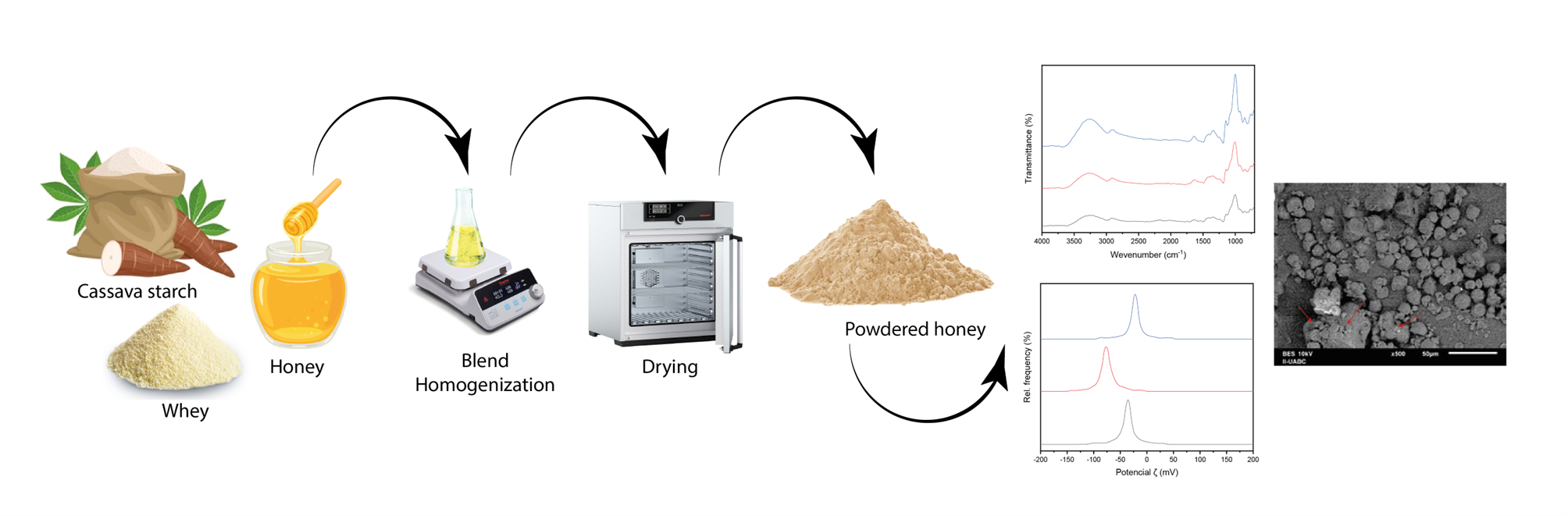
O mel é considerado um alimento nutritivo, produzido principalmente pelas abelhas (Apis mellifera L.) a partir do néctar das flores. No entanto, sua alta viscosidade e as dificuldades de manuseio impulsionaram o desenvolvimento da produção de mel em pó. O uso de adjuvantes como soro de leite e amido de mandioca, devido à sua versatilidade e disponibilidade, é uma opção viável para a produção de mel em pó. Portanto, misturas de mel, soro de leite e amido de mandioca foram avaliadas. As misturas foram secas em estufa de ar forçado a 60 °C por 24 h. Os pós resultantes foram caracterizados físico-quimicamente e analisados por FT-IR, DLS e MEV. A mistura com o maior teor de soro de leite apresentou uma tendência a diminuir ligeiramente os picos de absorção na faixa espectral de 1400 a 700 cm−1 na análise espectral de FT-IR. A estabilidade eletrostática apresentou valores de −34,7907 mV, um pico de distribuição de −35,3467 mV com condutividade de 0,0091 mS/cm e mobilidade eletroforética de −2,7116 µm*cm/Vs. A morfologia do pó resultante consistiu em partículas aglomeradas com grânulos de amido variando em tamanho de aproximadamente 45,7 a 90,2 µm. O soro do leite e o amido de mandioca são utilizados como adjuvantes e agentes estabilizantes na produção de mel em pó.
Referências
Allen, K. E., Carpenter, C. E., & Walsh, M. K. (2007). Influence of protein level and starch type on an extrusion‐expanded whey product. International Journal of Food Science & Technology, 42(8), 953–960. https://doi.org/10.1111/j.1365-2621.2006.01316.x DOI: https://doi.org/10.1111/j.1365-2621.2006.01316.x
AOAC. (2023). Official methods of analysis of AOAC International (22nd ed.). AOAC International.
Baglio, E. (2018). Honey: Processing Techniques and Treatments (pp. 15–22). https://doi.org/10.1007/978-3-319-65751-6_2 DOI: https://doi.org/10.1007/978-3-319-65751-6_2
Bravo-Núñez, Á., Garzón, R., Rosell, C. M., & Gómez, M. (2019). Evaluation of starch–protein interactions as a function of pH. Foods, 8(5), 155. https://doi.org/10.3390/foods8050155 DOI: https://doi.org/10.3390/foods8050155
Breuninger, W. F., Piyachomkwan, K., & Sriroth, K. (2009). Tapioca/cassava starch. In Starch (pp. 541–568). Elsevier. https://doi.org/10.1016/B978-0-12-746275-2.00012-4 DOI: https://doi.org/10.1016/B978-0-12-746275-2.00012-4
Britchenko, I., & Mickiewicz, B. (2022). Main trends and development forecast of bread and bakery products market. VUZF Review, 7(3), 113–123. https://doi.org/http://dx.doi.org/10.2139/ssrn.4235605 DOI: https://doi.org/10.38188/2534-9228.22.3.11
Chandrakar, N., Padhi, S., Saraugi, S. S., Sehrawat, R., Singh, A., & Routray, W. (2024). Whey protein and maltodextrin conjugated foam-mat dried honey powder: Functional, physicochemical, structural, rheological and thermal characterization. Chemical Engineering Research and Design, 209, 367–379. https://doi.org/10.1016/j.cherd.2024.08.015 DOI: https://doi.org/10.1016/j.cherd.2024.08.015
Chandrapala, J., Duke, M. C., Gray, S. R., Zisu, B., Weeks, M., Palmer, M., & Vasiljevic, T. (2015). Properties of acid whey as a function of pH and temperature. Journal of Dairy Science, 98(7), 4352–4363. https://doi.org/10.3168/jds.2015-9435 DOI: https://doi.org/10.3168/jds.2015-9435
Chaven, S. (2023). Confectionery and Bakery Products; Including Honey. In Food Safety Management (pp. 291–303). Elsevier. https://doi.org/10.1016/B978-0-12-820013-1.00045-0 DOI: https://doi.org/10.1016/B978-0-12-820013-1.00045-0
Dodds, J. (2024). Techniques to analyse particle size of food powders. In Handbook of Food Powders (pp. 249–268). Elsevier. https://doi.org/10.1016/B978-0-323-98820-9.00070-3 DOI: https://doi.org/10.1016/B978-0-323-98820-9.00070-3
Filomeni, G., Graziani, I., De Zio, D., Dini, L., Centonze, D., Rotilio, G., & Ciriolo, M. R. (2012). Neuroprotection of kaempferol by autophagy in models of rotenone-mediated acute toxicity: possible implications for Parkinson’s disease. Neurobiology of Aging, 33(4), 767–785. https://doi.org/10.1016/j.neurobiolaging.2010.05.021 DOI: https://doi.org/10.1016/j.neurobiolaging.2010.05.021
Hazlett, R., Schmidmeier, C., & O’Mahony, J. A. (2021). Approaches for improving the flowability of high-protein dairy powders post spray drying – A review. Powder Technology, 388, 26–40. https://doi.org/10.1016/j.powtec.2021.03.021 DOI: https://doi.org/10.1016/j.powtec.2021.03.021
He, R., Du, J., Feng, A., Zhang, J., Zhong, G., Fu, N., & Yang, T. (2025). Physical modification of cassava starch by alternating magnetic field treatment: Effects on fine structure, retrogradation and in vitro digestibility. Food Chemistry, 471, 142650. https://doi.org/10.1016/j.foodchem.2024.142650 DOI: https://doi.org/10.1016/j.foodchem.2024.142650
Ke, C., & Li, L. (2023). Influence mechanism of polysaccharides induced Maillard reaction on plant proteins structure and functional properties: A review. Carbohydrate Polymers, 302, 120430. https://doi.org/10.1016/j.carbpol.2022.120430 DOI: https://doi.org/10.1016/j.carbpol.2022.120430
Masyithoh, D., Jaya, F., Estiasih, T., Ira Febriani, S., Claudhia Falaq, E., & Kurniawan, F. (2025). Characterization of vacuum-dried honey powder: effect of honey type and carrier composition on functional, physicochemical, and antioxidant properties. International Journal of Food Properties, 28(1). https://doi.org/10.1080/10942912.2025.2557992 DOI: https://doi.org/10.1080/10942912.2025.2557992
Montes, C., Villaseñor, M. J., & Ríos, Á. (2019). Analytical control of nanodelivery lipid-based systems for encapsulation of nutraceuticals: Achievements and challenges. Trends in Food Science & Technology, 90, 47–62. https://doi.org/10.1016/j.tifs.2019.06.001 DOI: https://doi.org/10.1016/j.tifs.2019.06.001
Nabgan, M., Shariatifar, N., Jahed-Khaniki, G., Molaee-Aghaee, E., & Sani, M. A. (2025). Development and characterization of whey protein packaging film loaded with Pickering emulsion stabilized marjoram (Origanum majorana L.) essential oil. International Journal of Biological Macromolecules, 334, 149178. https://doi.org/10.1016/j.ijbiomac.2025.149178 DOI: https://doi.org/10.1016/j.ijbiomac.2025.149178
Pelegrine, D. H. G., & Gasparetto, C. A. (2005). Whey proteins solubility as function of temperature and pH. LWT - Food Science and Technology, 38(1), 77–80. https://doi.org/10.1016/j.lwt.2004.03.013 DOI: https://doi.org/10.1016/j.lwt.2004.03.013
Saji, R., Ramani, A., Gandhi, K., Seth, R., & Sharma, R. (2024). Application of FTIR spectroscopy in dairy products: A systematic review. Food and Humanity, 2, 100239. https://doi.org/10.1016/j.foohum.2024.100239 DOI: https://doi.org/10.1016/j.foohum.2024.100239
Samborska, K. (2019). Powdered honey – drying methods and parameters, types of carriers and drying aids, physicochemical properties and storage stability. Trends in Food Science & Technology, 88, 133–142. https://doi.org/10.1016/j.tifs.2019.03.019 DOI: https://doi.org/10.1016/j.tifs.2019.03.019
Samborska, K., Barańska-Dołomisiewicz, A., Jedlińska, A., Costa, R., Klimantakis, K., Mourtzinos, I., & Nowacka, M. (2025). Valorization of Spent Osmotic Solutions by Production of Powders by Spray Drying. Applied Sciences, 15(12), 6927. https://doi.org/10.3390/app15126927 DOI: https://doi.org/10.3390/app15126927
Santos, A. C. dos, Biluca, F. C., Braghini, F., Gonzaga, L. V., Costa, A. C. O., & Fett, R. (2021). Phenolic composition and biological activities of stingless bee honey: An overview based on its aglycone and glycoside compounds. Food Research International, 147, 110553. https://doi.org/10.1016/j.foodres.2021.110553 DOI: https://doi.org/10.1016/j.foodres.2021.110553
Saraugi, S. S., Chandrakar, N., Padhi, S., & Routray, W. (2026). Insights into honey powder production: Key factors, production methods, physicochemical characterization, and applications. Food Chemistry, 500, 147402. https://doi.org/10.1016/j.foodchem.2025.147402 DOI: https://doi.org/10.1016/j.foodchem.2025.147402
Sathivel, S. (2013). Application of honey powder in bread and its effect on bread characteristics. Journal of Food Processing & Technology, 04(11). https://doi.org/10.4172/2157-7110.1000279 DOI: https://doi.org/10.4172/2157-7110.1000279
Setiowati, A. D., Wijaya, W., & Van der Meeren, P. (2020). Whey protein-polysaccharide conjugates obtained via dry heat treatment to improve the heat stability of whey protein stabilized emulsions. Trends in Food Science & Technology, 98, 150–161. https://doi.org/10.1016/j.tifs.2020.02.011 DOI: https://doi.org/10.1016/j.tifs.2020.02.011
Simunkova, H., Pessenda-Garcia, P., Wosik, J., Angerer, P., Kronberger, H., & Nauer, G. E. (2009). The fundamentals of nano- and submicro-scaled ceramic particles incorporation into electrodeposited nickel layers: Zeta potential measurements. Surface and Coatings Technology, 203(13), 1806–1814. https://doi.org/10.1016/j.surfcoat.2008.12.031 DOI: https://doi.org/10.1016/j.surfcoat.2008.12.031
Soler, A., Dominguez-Ayala, J. E., Morales-Sánchez, E., Cabrera-Ramírez, Á. H., Sifuentes-Nieves, I., Velazquez, G., & Mendez-Montealvo, G. (2026). Unraveling the crystalline and double helical characteristics and their impact on the functionality of dry-heated cassava and corn starch. International Journal of Biological Macromolecules, 340, 150004. https://doi.org/10.1016/j.ijbiomac.2025.150004 DOI: https://doi.org/10.1016/j.ijbiomac.2025.150004
Suhag, Y., & Nanda, V. (2016). Optimization for spray drying process parameters of nutritionally rich honey powder using response surface methodology. Cogent Food & Agriculture, 2(1). https://doi.org/10.1080/23311932.2016.1176631 DOI: https://doi.org/10.1080/23311932.2016.1176631
Tenore, G. C., Ritieni, A., Campiglia, P., & Novellino, E. (2012). Nutraceutical potential of monofloral honeys produced by the Sicilian black honeybees (Apis mellifera ssp. sicula). Food and Chemical Toxicology, 50(6), 1955–1961. https://doi.org/10.1016/j.fct.2012.03.067 DOI: https://doi.org/10.1016/j.fct.2012.03.067
Tomczyk, M., Zaguła, G., Tarapatskyy, M., Kačániová, M., & Dżugan, M. (2021). The effect of honey variety on the quality of honey powder. Journal of Microbiology, Biotechnology and Food Sciences, 9(5), 949–954. https://doi.org/10.15414/jmbfs.2020.9.5.949-954 DOI: https://doi.org/10.15414/jmbfs.2020.9.5.949-954
Toniazzo, T., Collado-González, M., Tadini, C. C., & Mackie, A. R. (2023). Evaluation of physicochemical properties of honey powder using rice and pea proteins as carriers. Food Research International, 167, 112692. https://doi.org/10.1016/j.foodres.2023.112692 DOI: https://doi.org/10.1016/j.foodres.2023.112692
Torley, P. J., Rutgers, R. P. G., D’Arcy, B., & Bhandari, B. R. (2004). Effect of honey types and concentration on starch gelatinization. LWT - Food Science and Technology, 37(2), 161–170. https://doi.org/10.1016/j.lwt.2003.08.002 DOI: https://doi.org/10.1016/j.lwt.2003.08.002
Verma, D. K., Patel, A. R., Tripathy, S., Gupta, A. K., Singh, S., Shah, N., Utama, G. L., Chávez-González, M. L., Zongo, K., Banwo, K., Niamah, A. K., & Aguilar, C. N. (2024). Processing and formulation technology of nutritional and functional food products by utilizing cheese and/or paneer whey: A critical review. Journal of King Saud University - Science, 36(11), 103508. https://doi.org/10.1016/j.jksus.2024.103508 DOI: https://doi.org/10.1016/j.jksus.2024.103508
Vosoghi, M., Yousefi, S., & Honarvar, M. (2025). Physicochemical and sensory properties of honey powder from different climatic regions. Applied Food Research, 5(1), 100843. https://doi.org/10.1016/j.afres.2025.100843 DOI: https://doi.org/10.1016/j.afres.2025.100843
Wang, Z., Mhaske, P., Farahnaky, A., Kasapis, S., & Majzoobi, M. (2022). Cassava starch: Chemical modification and its impact on functional properties and digestibility, a review. Food Hydrocolloids, 129, 107542. https://doi.org/10.1016/j.foodhyd.2022.107542 DOI: https://doi.org/10.1016/j.foodhyd.2022.107542
Wu, Y., & Guo, Q. (2025). Effect of whey protein on the formation, structure and gastrointestinal breakdown of quinoa flour-based composite gels. Food Hydrocolloids, 160, 110775. https://doi.org/10.1016/j.foodhyd.2024.110775 DOI: https://doi.org/10.1016/j.foodhyd.2024.110775
Yadav, R., Aralkar, S., Prasad, K. V., Firake, D. M., Aradwad, P., Raju, D. V. S., & Kv, S. (2026). Trends in honey spray drying: A comprehensive analysis of drying conditions, process optimization, physicochemical properties, honey powder enrichment and industrial applications. Trends in Food Science & Technology, 168, 105508. https://doi.org/10.1016/j.tifs.2025.105508 DOI: https://doi.org/10.1016/j.tifs.2025.105508
Yamul, D. K., & Lupano, C. E. (2005). Whey protein concentrate gels with honey and wheat flour. Food Research International, 38(5), 511–522. https://doi.org/10.1016/j.foodres.2004.11.005 DOI: https://doi.org/10.1016/j.foodres.2004.11.005
Zhang, J., Liu, Y., Wang, P., Zhao, Y., Zhu, Y., & Xiao, X. (2025). The Effect of Protein–Starch Interaction on the Structure and Properties of Starch, and Its Application in Flour Products. Foods, 14(5), 778. https://doi.org/10.3390/foods14050778 DOI: https://doi.org/10.3390/foods14050778
Zhang, X., Wang, Q., Liu, Z., Zhi, L., Jiao, B., Hu, H., Ma, X., Agyei, D., & Shi, A. (2023). Plant protein-based emulsifiers: Mechanisms, techniques for emulsification enhancement and applications. Food Hydrocolloids, 144, 109008. https://doi.org/10.1016/j.foodhyd.2023.109008 DOI: https://doi.org/10.1016/j.foodhyd.2023.109008
Zhen, Y., Wang, K., Wang, J., Qiao, D., Zhao, S., Lin, Q., & Zhang, B. (2022). Increasing the pH value during thermal processing suppresses the starch digestion of the resulting starch-protein-lipid complexes. Carbohydrate Polymers, 278, 118931. https://doi.org/10.1016/j.carbpol.2021.118931 DOI: https://doi.org/10.1016/j.carbpol.2021.118931
Zhu, F. (2015). Interactions between starch and phenolic compound. Trends in Food Science & Technology, 43(2), 129–143. https://doi.org/10.1016/j.tifs.2015.02.003 DOI: https://doi.org/10.1016/j.tifs.2015.02.003
Downloads
Publicado
Como Citar
Edição
Seção
Licença
Copyright (c) 2026 Ulin Antobelli Basilio-Cortes, Daniel González-Mendoza, Dagoberto Durán-Hernández, Alexis Alejandro Salazar-Navarro, Benjamín Valdez-Salas, Ernesto Beltrán-Partida, José Gregorio Joya-Dávila, Lourdes González-Salitre

Este trabalho está licenciado sob uma licença Creative Commons Attribution 4.0 International License.
Esta revista publica seus artigos em Acesso Aberto sob licença Creative Commons (CC BY 4.0).
Você é livre para:
Compartilhar — copie e redistribua o material em qualquer meio ou formato para qualquer finalidade, inclusive comercial.
Adaptar – remixar, transformar e desenvolver o material para qualquer finalidade, até mesmo comercial.
O licenciante não pode revogar essas liberdades desde que você siga os termos da licença.
Nos seguintes termos:
Atribuição — Você deve dar o devido crédito, fornecer um link para a licença e indicar se foram feitas alterações. Você pode fazê-lo de qualquer maneira razoável, mas não de forma que sugira que o licenciante endossa você ou seu uso.
Sem restrições adicionais — Você não pode aplicar termos legais ou medidas tecnológicas que restrinjam legalmente outras pessoas de fazerem qualquer coisa que a licença permita.
Avisos:
Você não precisa cumprir a licença para elementos do material de domínio público ou onde seu uso for permitido por uma exceção ou limitação aplicável.
Nenhuma garantia é dada. A licença pode não conceder todas as permissões necessárias para o uso pretendido. Por exemplo, outros direitos, como publicidade, privacidade ou direitos morais, podem limitar a forma como você utiliza o material.