
Dynamic model inspired by artificial intelligence for engineering education and complex systems design: a nonlinear differential systems approach
DOI:
https://doi.org/10.58951/dataset.2026.001Keywords:
Artificial Intelligence, Mathematical Modeling, Engineering Education, Dynamic Systems, Adaptive Learning, Intelligent Educational SystemsAbstract
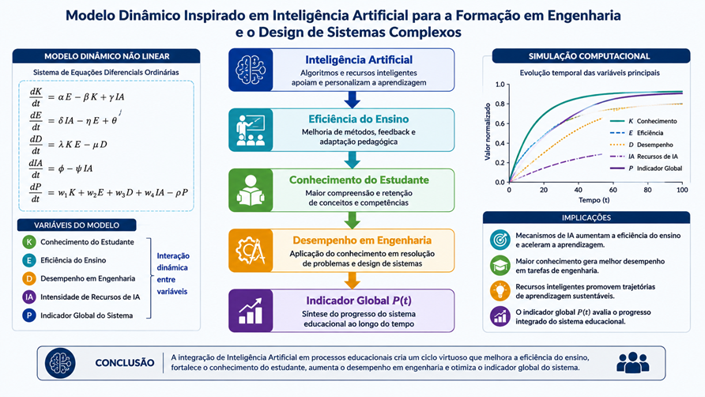
The growing integration of Artificial Intelligence (AI) into higher education has stimulated the development of innovative solutions to enhance teaching and learning processes; however, a significant gap remains in the formulation of mathematical models capable of explicitly representing the dynamics among learning, academic performance, and intelligent technological support, particularly in engineering education. This study proposes a nonlinear dynamic mathematical model inspired by AI-based adaptive mechanisms to analyze the interactions among student knowledge, teaching efficiency, engineering performance, and the use of intelligent learning support resources. The research adopted a quantitative approach based on mathematical modeling and computational simulation, using a system of ordinary differential equations implemented in the R programming language. Numerical integration was performed using the fourth-order Runge-Kutta method, and a sensitivity analysis of the main model parameters was conducted. The simulation results indicate that AI-inspired adaptive mechanisms promote increased knowledge acquisition, improved pedagogical efficiency, and sustained growth in students’ technical performance. The adaptive scenario supported by intelligent resources outperformed the traditional scenario, demonstrating faster and more sustainable learning trajectories. Furthermore, the sensitivity analysis confirmed the structural robustness of the proposed model under small parameter perturbations. It is concluded that dynamic modeling represents a promising framework for understanding and optimizing complex educational systems, providing a theoretical foundation for future empirical validation studies and the development of intelligent engineering education environments.
References
Baker, R. S., & Inventado, P. S. (2014). Educational Data Mining and Learning Analytics. In Learning Analytics (pp. 61–75). Springer New York. https://doi.org/10.1007/978-1-4614-3305-7_4
Boyce, W. E., DiPrima, R. C., & Meade, D. B. (2021). Elementary differential equations and boundary value problems (12th ed.). John Wiley & Sons.
Celik, I., Dindar, M., Muukkonen, H., & Järvelä, S. (2022). The Promises and Challenges of Artificial Intelligence for Teachers: a Systematic Review of Research. TechTrends, 66(4), 616–630. https://doi.org/10.1007/s11528-022-00715-y
Falebita, O. S., & Kok, P. J. (2024). Strategic goals for artificial intelligence integration among STEM academics and undergraduates in African higher education: a systematic review. Discover Education, 3(1), 151. https://doi.org/10.1007/s44217-024-00252-1
Grassini, S. (2023). Shaping the Future of Education: Exploring the Potential and Consequences of AI and ChatGPT in Educational Settings. Education Sciences, 13(7), 692. https://doi.org/10.3390/educsci13070692
Hadgraft, R. G., & Kolmos, A. (2020). Emerging learning environments in engineering education. Australasian Journal of Engineering Education, 25(1), 3–16. https://doi.org/10.1080/22054952.2020.1713522
Hlongwane, J., Shava, George. N., Mangena, A., & Muzari, T. (2024). Towards the Integration of Artificial Intelligence in Higher Education, Challenges and Opportunities: The African Context, a Case of Zimbabwe. International Journal of Research and Innovation in Social Science, VIII(IIIS), 417–435. https://doi.org/10.47772/IJRISS.2024.803028S
Holmes, W., Bialik, M., & Fadel, C. (2019). Artificial Intelligence in Education. Promise and Implications for Teaching and Learning. Center for Curriculum Redesign.
Kasneci, E., Sessler, K., Küchemann, S., Bannert, M., Dementieva, D., Fischer, F., Gasser, U., Groh, G., Günnemann, S., Hüllermeier, E., Krusche, S., Kutyniok, G., Michaeli, T., Nerdel, C., Pfeffer, J., Poquet, O., Sailer, M., Schmidt, A., Seidel, T., … Kasneci, G. (2023). ChatGPT for good? On opportunities and challenges of large language models for education. Learning and Individual Differences, 103, 102274. https://doi.org/10.1016/j.lindif.2023.102274
Mustafa, M. Y., Tlili, A., Lampropoulos, G., Huang, R., Jandrić, P., Zhao, J., Salha, S., Xu, L., Panda, S., Kinshuk, López-Pernas, S., & Saqr, M. (2024). A systematic review of literature reviews on artificial intelligence in education (AIED): a roadmap to a future research agenda. Smart Learning Environments, 11(1), 59. https://doi.org/10.1186/s40561-024-00350-5
OECD. (2021). AI and the Future of Skills, Volume 1: Capabilities and Assessments (Educational Research and Innovation, Ed.). OECD Publishing. https://doi.org/10.1787/5ee71f34-en
Russell, S. J., & Norvig, P. (2021). Artificial intelligence: A modern approach (4th ed.). Pearson Education .
Strogatz, S. H. (2018). Nonlinear dynamics and chaos: With applications to physics, biology, chemistry and engineering (2nd ed.). CRC Press.
UNESCO. (2023). Guidance for generative AI in education and research. UNESCO Publishing.
Zawacki-Richter, O., Marín, V. I., Bond, M., & Gouverneur, F. (2019). Systematic review of research on artificial intelligence applications in higher education – where are the educators? International Journal of Educational Technology in Higher Education, 16(1), 39. https://doi.org/10.1186/s41239-019-0171-0
Downloads
Published
How to Cite
Issue
Section
License
Copyright (c) 2026 Infeliz Carvalho Coxe, Acácio da Conceição de Jesus Domingos

This work is licensed under a Creative Commons Attribution 4.0 International License.
This journal publishes its Open Access articles under a Creative Commons license (CC BY 4.0).
You are free to:
Share — copy and redistribute the material in any medium or format for any purpose, even commercially.
Adapt — remix, transform, and build upon the material for any purpose, even commercially.
The licensor cannot revoke these freedoms as long as you follow the license terms.
Under the following terms:
Attribution — You must give appropriate credit, provide a link to the license, and indicate if changes were made. You may do so in any reasonable manner, but not in any way that suggests the licensor endorses you or your use.
No additional restrictions — You may not apply legal terms or technological measures that legally restrict others from doing anything the license permits.
Notices:
You do not have to comply with the license for elements of the material in the public domain or where your use is permitted by an applicable exception or limitation.
No warranties are given. The license may not give you all of the permissions necessary for your intended use. For example, other rights such as publicity, privacy, or moral rights may limit how you use the material.