
Vacuum osmotic dehydration of cashew apple peduncle using concentrated cashew apple juice as an osmotic agent
- Authors
-
-
Antonio Calixto Lima
Embrapa Agroindústria Tropical
-
Edy Souza de Brito
Embrapa Agroindústria Tropical
-
Arthur Claudio Rodrigues de Souza
Embrapa Agroindústria Tropical
-
- Keywords:
- Pseudofruit, Anacardium occidentale L, Response surface, Ascorbic acid, Concentration, Dehydration, Osmosis
- Abstract
-
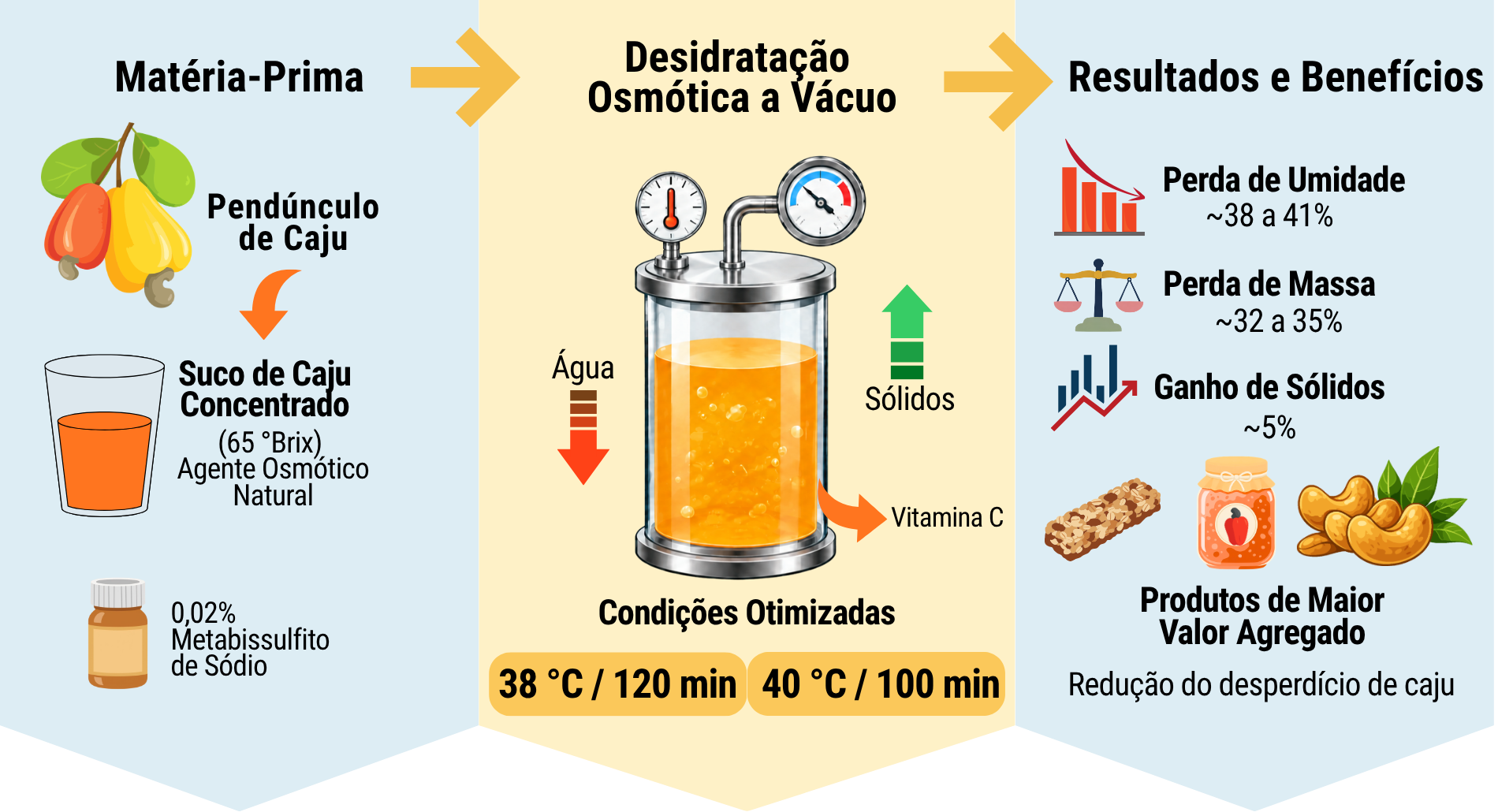
Despite the economic and social importance of the cashew (Anacardium occidentale L.) to the Northeast region, currently less than 15% of the annual cashew apple production – estimated at 1 million tons – is utilized. This study aimed to contribute to increasing the utilization of the cashew pseudo–fruit by optimizing the osmotic dehydration process, seeking to obtain a product with maximum moisture loss and minimum solids gain. The research involved the vacuum dehydration of cashew apple slices using vacuum–concentrated cashew juice (65 °Brix) as the osmotic agent, along with 0.02% (m/m) sodium metabisulfite as an antioxidant. The process utilized natural circulation equipment equipped with temperature and pressure gauges, a vacuum pump, and heating and cooling systems. Two optimized time–temperature combinations – determined via Response Surface Methodology – were analyzed: 40 °C/100 min and 38 °C/120 min. Under these conditions, the results obtained were, respectively: mass loss of 32.67% and 35.50%; solids gain of 5.39% and 5.66%; and moisture loss of 38.58% and 40.97%. Research has shown that concentrated cashew apple juice serves as a viable alternative to sucrose, yielding results similar to those obtained with sucrose syrup during the dehydration of cashew apple slices. Furthermore, its high content of antioxidant compounds – such as ascorbic acid (averaging 960 mg/100 g) – can enhance the nutritional value of the dehydrated product. It also helps mitigate the significant waste associated with cashew apples, as this technology enables the creation of higher–value–added products, such as cereal bars, fruit preserves, and dried cashew apple.
- Downloads
-
Download data is not yet available.
- References
-
Ahmed, I., Qazi, I. M., & Jamal, S. (2016). Developments in osmotic dehydration technique for the preservation of fruits and vegetables. Innovative Food Science & Emerging Technologies, 34, 29–43. https://doi.org/10.1016/j.ifset.2016.01.003 DOI: https://doi.org/10.1016/j.ifset.2016.01.003
Akbarian, M., Ghasemkhani, N., & Moayedi, F. (2014). Osmotic dehydration of fruits in food industrial: A review. International Journal of Biosciences (IJB), 4(1), 42–57. https://doi.org/10.12692/ijb/4.1.42-57 DOI: https://doi.org/10.12692/ijb/4.1.42-57
Akharume, F., Smith, A., Sivanandan, L., & Singh, K. (2019). Recent progress on osmo-convective dehydration of fruits. SDRP Journal of Food Science & Technology, 4(9), 956–969. https://doi.org/10.25177/JFST.4.9.RA.613 DOI: https://doi.org/10.25177/JFST.4.9.RA.613
Akyereko, Y. G., Yeboah, G. B., Wireko‐Manu, F. D., Alemawor, F., Mills‐Robertson, F. C., & Odoom, W. (2023). Nutritional value and health benefits of cashew apple. JSFA Reports, 3(3), 110–118. https://doi.org/10.1002/jsf2.107 DOI: https://doi.org/10.1002/jsf2.107
Alfaro, L., Siramard, S., Chouljenko, A., & Sathivel, S. (2018). Effects of liquid nitrogen pretreatment on the osmotic dehydration and quality of cryogenically frozen blueberries ( Vaccinium angustifolium Ait.). Food Bioscience, 22, 165–169. https://doi.org/10.1016/j.fbio.2018.02.006 DOI: https://doi.org/10.1016/j.fbio.2018.02.006
AOAC International. (2012). Official Methods of Analysis. In Jr. Latimer, G. W. (Ed.), Official Methods of Analysis of AOAC INTERNATIONAL. AOAC International. https://doi.org/10.1093/9780197610145.002.001 DOI: https://doi.org/10.1093/9780197610145.002.001
Asghari, A., Zongo, P. A., Osse, E. F., Aghajanzadeh, S., Raghavan, V., & Khalloufi, S. (2024). Review of osmotic dehydration: Promising technologies for enhancing products’ attributes, opportunities, and challenges for the food industries. Comprehensive Reviews in Food Science and Food Safety, 23(3). https://doi.org/10.1111/1541-4337.13346 DOI: https://doi.org/10.1111/1541-4337.13346
Assis, F. R., Morais, R. M. S. C., & Morais, A. M. M. B. (2017). Mathematical modelling of osmotic dehydration kinetics of apple cubes. Journal of Food Processing and Preservation, 41(3), e12895. https://doi.org/10.1111/jfpp.12895 DOI: https://doi.org/10.1111/jfpp.12895
Azevedo, D. C. S., & Rodrigues, A. (2000). SMB chromatography applied to the separation/purification of fructose from cashew apple juice. Brazilian Journal of Chemical Engineering, 17(4–7), 507–516. https://doi.org/10.1590/S0104-66322000000400015 DOI: https://doi.org/10.1590/S0104-66322000000400015
Azoubel, P. M., & Murr, F. E. X. (2003). Optimisation of Osmotic Dehydration of Cashew Apple (Anacardium Occidentale L.) in Sugar Solutions. Food Science and Technology International, 9(6), 427–433. https://doi.org/10.1177/1082013203040908 DOI: https://doi.org/10.1177/1082013203040908
Baniwal, P., & Hathan, B. S. (2015). Process parameter optimization for the development of ready-to-eat instant sand pear candy using response surface methodology. Journal of Food Processing and Preservation, 39(6), 3098–3109. https://doi.org/10.1111/jfpp.12575 DOI: https://doi.org/10.1111/jfpp.12575
Boeira, J. B., Stringari, G. B., & Laurindo, J. B. (2007). Estudo da desidratação de pêssegos por tratamento osmótico e secagem. Boletim Do Centro de Pesquisa de Processamento de Alimentos, 25(1). https://doi.org/10.5380/cep.v25i1.8396 DOI: https://doi.org/10.5380/cep.v25i1.8396
Brainer, M. S. D. C. P. (2021). Cajucultura: O aproveitamento do pedúnculo. Caderno Setorial ETENE, 6(190), 1–19. https://www.bnb.gov.br/s482-dspace/bitstream/123456789/990/3/2021_CDS_190.pdf
Brainer, M. S. de C. P., & Vidal, M. de F. (2020). Cajucultura. Caderno Setorial ETENE, 5(114), 1–16. https://www.bnb.gov.br/revista/cse/article/view/2842/1944
Chandra, S., & Kumari, D. (2015). Recent development in osmotic dehydration of fruit and vegetables: A review. Critical Reviews in Food Science and Nutrition, 55(4), 552–561. https://doi.org/10.1080/10408398.2012.664830 DOI: https://doi.org/10.1080/10408398.2012.664830
Coimbra, L. M. P. de L., Arruda, H. A. S. de, Machado, E. de C. L., Salgado, S. M., Albuquerque, S. S. M. C. de, & Andrade, S. A. C. (2017). Water and sucrose diffusion coefficients during osmotic dehydration of sapodilla (Achras zapota L.). Ciência Rural, 47(8). https://doi.org/10.1590/0103-8478cr20150924 DOI: https://doi.org/10.1590/0103-8478cr20150924
Das, I., & Arora, A. (2017). Post-harvest processing technology for cashew apple – A review. Journal of Food Engineering, 194, 87–98. https://doi.org/10.1016/j.jfoodeng.2016.09.011 DOI: https://doi.org/10.1016/j.jfoodeng.2016.09.011
Dimoso, N., Makule, E., & Kassim, N. (2020). Quality assessment of formulated osmotically dehydrated cashew apple (Anacardium occidentale L.) slices dried using hot air and solar driers. International Journal of Biosciences (IJB), 421–432. https://doi.org/10.12692/ijb/17.6.421-432 DOI: https://doi.org/10.12692/ijb/17.6.421-432
Egea, M. B., & Lobato, L. P. (2014). A desidratação osmótica como pré-tratamento para frutas e hortaliças. Revista Do Instituto Adolfo Lutz, 73(4), 316–324. https://doi.org/10.18241/0073-98552014731621 DOI: https://doi.org/10.18241/0073-98552014731621
Guiné, R. P. F. (2018). The Drying of Foods and Its Effect on the Physical-Chemical, Sensorial and Nutritional Properties. ETP International Journal of Food Engineering, 93–100. https://doi.org/10.18178/ijfe.4.2.93-100 DOI: https://doi.org/10.18178/ijfe.4.2.93-100
Instituto Adolfo Lutz. (1985). Normas analíticas do Instituto Adolfo Lutz: Métodos químicos e físicos para análise de alimentos (3rd ed., Vol. 1). Imprensa Oficial do Estado de São Paulo.
Kaur, D., Singh, M., Zalpouri, R., & Singh, I. (2022). Osmotic dehydration of fruits using unconventional natural sweeteners and non‐thermal‐assisted technologies: A review. Journal of Food Processing and Preservation, 46(12). https://doi.org/10.1111/jfpp.16890 DOI: https://doi.org/10.1111/jfpp.16890
Kaushalya, W. K. D. N., & Weerasooriya, M. K. B. (2017). Development of value added product from cashew apple using dehydration processes. Journal of Scientific and Industrial Research, 76(2), 105–109.
Landim, A. P. M., Barbosa, M. I. M. J., & Barbosa Júnior, J. L. (2016). Influence of osmotic dehydration on bioactive compounds, antioxidant capacity, color and texture of fruits and vegetables: a review. Ciência Rural, 46(10), 1714–1722. https://doi.org/10.1590/0103-8478cr20150534 DOI: https://doi.org/10.1590/0103-8478cr20150534
Lima, A. C., García, N. H. P., & Lima, J. R. (2004). Obtenção e caracterização dos principais produtos do caju. Boletim Do Centro de Pesquisa de Processamento de Alimentos, 22(1). https://doi.org/10.5380/cep.v22i1.1185 DOI: https://doi.org/10.5380/cep.v22i1.1185
Mari, A., Parisouli, D. N., & Krokida, M. (2024). Exploring osmotic dehydration for food preservation: Methods, modelling, and modern applications. Foods, 13(17), 2783. https://doi.org/10.3390/foods13172783 DOI: https://doi.org/10.3390/foods13172783
Meneses, J. (2018). Osmoconvective dehydration in fruits and vegetables: A review of recent developments. Agroindustrial Science, 8(1), 67–72. https://doi.org/10.17268/agroind.science.2018.01.10 DOI: https://doi.org/10.17268/agroind.sci.2018.01.10
P, P., M, S., Sanikommu, V. R., G L, V., Kalal, P., & Ravi, P. (2023). Biochemical quality comparison of forced air dried osmo-dehydrated cashew apple products infused with spice mixture and sugar. Journal of Horticultural Sciences, 18(2). https://doi.org/10.24154/jhs.v18i2.2015 DOI: https://doi.org/10.24154/jhs.v18i2.2015
Querido, A. F. (2000). Otimização e comparação dos processos de desidratação osmótica a vácuo e a pressão ambiente de pseudofruto de caju [Dissertação de Mestrado]. Universidade Estadual de Campinas.
Ramya, V., & Jain, N. K. (2017). A review on osmotic dehydration of fruits and vegetables: An integrated approach. Journal of Food Process Engineering, 40(3). https://doi.org/10.1111/jfpe.12440 DOI: https://doi.org/10.1111/jfpe.12440
Rodrigues, M. I., & Iemma, A. F. (2014). Experimental Design and Process Optimization (1st ed.). CRC Press. https://doi.org/10.1201/b17848 DOI: https://doi.org/10.1201/b17848
Sulistyawati, I., Verkerk, R., Fogliano, V., & Dekker, M. (2020). Modelling the kinetics of osmotic dehydration of mango: Optimizing process conditions and pre-treatment for health aspects. Journal of Food Engineering, 280, 109985. https://doi.org/10.1016/j.jfoodeng.2020.109985 DOI: https://doi.org/10.1016/j.jfoodeng.2020.109985
Vidal, M. de F. (2026). Cajucultura. Caderno Setorial ETENE, 11(425), 1–11. https://www.bnb.gov.br/revista/cse/article/view/3378
- Cover Image
-
- Downloads
- Published
- 2026-10-20
- Issue
- Vol. 5 No. 1 (2026)
- Section
- Research Article
- License
-
Copyright (c) 2026 Antonio Calixto Lima, Edy Souza de Brito, Arthur Claudio Rodrigues de Souza

This work is licensed under a Creative Commons Attribution 4.0 International License.
This journal publishes its Open Access articles under a Creative Commons license (CC BY 4.0).
You are free to:
Share — copy and redistribute the material in any medium or format for any purpose, even commercially.
Adapt — remix, transform, and build upon the material for any purpose, even commercially.
The licensor cannot revoke these freedoms as long as you follow the license terms.Under the following terms:
Attribution — You must give appropriate credit, provide a link to the license, and indicate if changes were made. You may do so in any reasonable manner, but not in any way that suggests the licensor endorses you or your use.No additional restrictions — You may not apply legal terms or technological measures that legally restrict others from doing anything the license permits.
Notices:
You do not have to comply with the license for elements of the material in the public domain or where your use is permitted by an applicable exception or limitation.No warranties are given. The license may not give you all of the permissions necessary for your intended use. For example, other rights such as publicity, privacy, or moral rights may limit how you use the material.

How to Cite




Similar Articles
- Bruno Luís Ferreira, Vitória Feilstrecker Bohn, Lissandra Waltrich, Jane Mara Block, Daniel Granato, Itaciara Larroza Nunes, Ultrasound-assisted extraction using [BMIM][Cl] ionic liquid as an effective method for recovering phenolic compounds from the coproduct of guava processing , Food Science Today: Vol. 1 No. 1 (2023)
- Suelen Ávila, Polyanna Silveira Hornung, Claudia Carneiro Hecke Kruger, Sila Mary Rodrigues Ferreira, Ultrasound-assisted extraction optimization of polyphenols from jambolão (Syzygium cumini) fruit and their in vitro antioxidant capacity , Food Science Today: Vol. 1 No. 1 (2023)
- Paula Juliana Silva, Maycon Jonathan Brandt Gross, Marianne Ayumi Shirai, Quantification of bioactive compounds from Clitoria ternatea L. kombucha , Food Science Today: Vol. 3 No. 1 (2024)
- Zaira Daniela Solís-Macías, Jesús Guadalupe Pérez-Flores , Laura García-Curiel , Luis Guillermo González-Olivares , Gabriela Mariana Rodríguez-Serrano, Elizabeth Contreras-López , Alexis Ayala-Niño , Emmanuel Pérez-Escalante, Lactic acid bacteria in wheat fermentation: A bibliometric analysis of antioxidant peptide production , Food Science Today: Vol. 4 No. 1 (2025)
- Helayne Aparecida Maieves, Bruna Vaz da Silva, Marielly Ewerling, Ugo Ribeiro Comparotto, Francielly Becker Lessa, Amábile Nunes Lemos, Júlia Porto Hepp, The behavior of lemon-based thickened fluids submitted to the IDDSI flow test as a strategy for dysphagia treatment , Food Science Today: Vol. 1 No. 1 (2023)
- Gabriela Hernández-Lozada, Jesús Guadalupe Pérez-Flores , Laura García-Curiel , Luis Guillermo González-Olivares , Elizabeth Contreras-López , Meyli Claudia Escobar-Ramírez , Emmanuel Pérez-Escalante, Application of bacteriocins in food preservation and safety: A bibliometric analysis approach , Food Science Today: Vol. 4 No. 1 (2025)
- Vanessa de Souza Marinho, Ludmylla Negreiros do Nascimento, Bruna Ribeiro de Lima, Jaime Paiva Lopes Aguiar, Francisca das Chagas do Amaral Souza, Development and nutritional characterization of chips made with tucumã-do-Amazonas flour (Astrocaryum aculeatum): a healthy and sustainable alternative for food consumption , Food Science Today: Vol. 4 No. 1 (2025)
You may also start an advanced similarity search for this article.